
The Importance of Choosing the Right Motorcycle Engine Oil in Africa
Choosing the right motorcycle engine oil in Africa is essential for maintaining engine performance and extending the service life of motorcycles used for urban and intercity transportation.
Motorcycles play an important role in passenger transport, goods delivery, and commercial activities in many African countries.
In countries such as Nigeria, Benin, Togo, and Uganda, commercial motorcycle transport services are known by names such as Okada, Zemidjan, and Boda Boda. Continuous operation, heavy traffic, and varying road conditions make proper lubricant selection especially important for riders, mechanics, and lubricant distributors.
Common Motorcycle Engine Oil Grades in African Markets
One of the challenges in motorcycle maintenance is the lack of sufficient technical awareness regarding the selection of engine oil that matches the motorcycle’s requirements.
Using unsuitable oil can negatively affect lubrication system performance. Therefore, educating consumers, motorcycle mechanics, and oil service providers is essential.
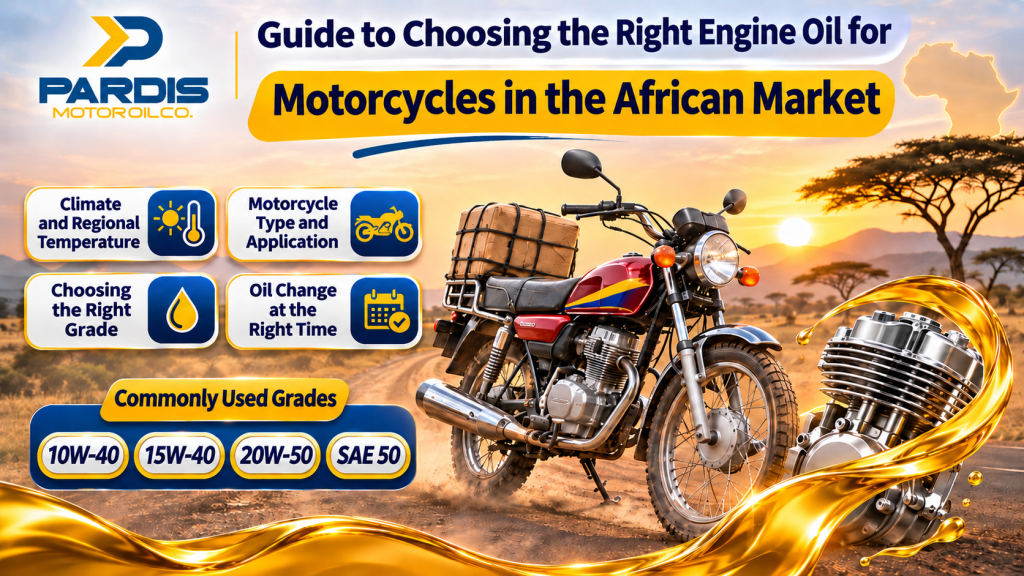
Viscosity grades such as 10W-40, 15W-40, 20W-50, and SAE 50 may be available in motorcycle lubricant markets. However, their suitability depends on the engine type and the manufacturer’s specifications.
10W-40 Engine Oil: Compared with 20W-50, this grade offers more favorable low-temperature starting characteristics and is used in certain four-stroke motorcycles.
15W-40 Engine Oil: This viscosity grade is also available in some formulations specifically designed for four-stroke motorcycles. Its use must comply with the engine’s required viscosity and performance standards.
20W-50 Engine Oil: This grade has a higher viscosity at operating temperatures than 10W-40 and may be suitable for certain motorcycles whose manufacturers approve its use.
SAE 50 Engine Oil: Unlike the previous three grades, SAE 50 is a single-grade oil. It does not provide the same low-temperature characteristics as multigrade oils and should not replace the manufacturer’s recommended motorcycle oil without explicit approval.
However, without reliable sales data, none of these grades can accurately be identified as the best-selling motorcycle oil across the entire African continent.
The Impact of Hot Climates and Heavy Motorcycle Usage
In many African regions, motorcycles operate under high ambient temperatures, heavy traffic, frequent stops, and long-distance riding conditions.
These operating conditions can increase demands on the lubrication system, making oxidation resistance, viscosity stability, and effective engine component protection particularly important.
Nevertheless, choosing thicker engine oil solely because of hot weather is not necessarily correct. The appropriate lubricant must be selected according to engine design, operating conditions, and manufacturer-approved viscosity grades.
The Importance of JASO Standards in Motorcycle Engine Oil
One of the major differences between motorcycle and passenger car engine oils is that many four-stroke motorcycles require a single lubricant to serve the engine, gearbox, and clutch.
The JASO T903 standard establishes performance requirements for four-stroke motorcycle engine oils, including their frictional characteristics.
JASO MA and JASO MA2 classifications are intended for motorcycles equipped with wet clutches. In contrast, JASO MB is suitable for certain scooters and motorcycles that do not require wet-clutch friction characteristics.
Therefore, motorcycle engine oil should not be selected based on viscosity alone. Compliance with the recommended JASO classification and other applicable performance requirements is equally important.
Choosing Oil for Four-Stroke and Two-Stroke Motorcycles
Four-stroke and two-stroke motorcycle engines have fundamentally different lubrication requirements.
In many four-stroke engines, oil circulates through a lubrication system, helping reduce friction, control heat, and protect internal engine components.
Two-stroke engines, on the other hand, require oil specifically formulated for their lubrication system. Four-stroke engine oil should not be substituted for two-stroke oil unless explicitly approved by the manufacturer.
For this reason, motorcycle owners should consider engine type, viscosity grade, performance standards, and manufacturer recommendations when choosing lubricants.
Market Opportunities for Motorcycle Engine Oil in Africa
The extensive commercial use of motorcycles in parts of Africa creates opportunities for lubricant manufacturers, exporters, and distributors.
Understanding motorcycle models used in each country, engine types, consumption patterns, and customer requirements can help suppliers provide products that match local market needs.
Educating mechanics and consumers about appropriate viscosity grades, JASO standards, product authenticity, and oil change intervals can also contribute to better motorcycle maintenance practices.
Conclusion: Choosing the Right Oil for Better Motorcycle Durability
Selecting the right motorcycle engine oil in Africa requires careful consideration of viscosity grade, JASO classification, engine type, and actual operating conditions.
Grades such as 10W-40, 15W-40, 20W-50, and SAE 50 may be suitable for specific applications, but none should be considered universally appropriate for all motorcycles.
Pardis Motor Oil Company emphasizes the importance of understanding the technical requirements of export markets and selecting lubricants that meet engine specifications, operating conditions, and relevant performance standards.