
The Importance of Engine Oil Additives in Lubricant Performance
Engine oil is more than just base oil. It is a carefully engineered formulation of base oils and chemical additives designed to protect engines under various operating conditions.
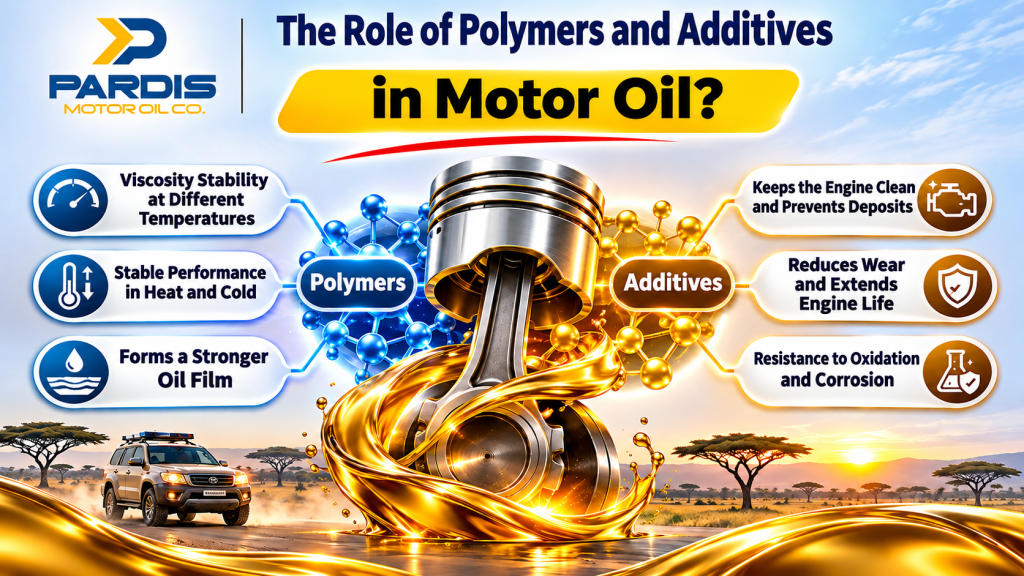
Engine oil additives play an essential role in improving lubricant performance by reducing wear, controlling deposits, and maintaining oil stability. Polymers, which can also function as additives, are used in certain formulations to control viscosity and improve oil behavior across different temperatures.
What Is the Role of Polymers in Engine Oil?
Polymers used as viscosity modifiers (VMs) are generally long-chain molecules that help reduce the rate at which oil viscosity decreases as temperature rises.
These compounds improve the Viscosity Index (VI), making it possible to formulate multigrade engine oils that maintain the required viscosity characteristics across a broader temperature range.
Common polymer technologies used in lubricants include Olefin Copolymers (OCP) and Polymethacrylates (PMA).
How Do Engine Oil Additives Protect Engine Components?
Engine oil additives include a wide range of chemical compounds, each designed to perform a specific function within the lubricant formulation.
Anti-Wear Additives: Compounds such as Zinc Dialkyldithiophosphate (ZDDP) help reduce component wear by forming protective films on metal surfaces under certain operating conditions.
Detergent Additives: These additives help control deposits and neutralize some of the acidic compounds generated during engine operation.
Dispersant Additives: Dispersants help keep contaminants and insoluble particles suspended in the oil, reducing their tendency to accumulate as sludge and deposits.
Antioxidant Additives: Antioxidants slow down oil oxidation and help maintain the lubricant’s chemical stability during operation.
Anti-Foam Additives: These compounds help control persistent foam formation, supporting the proper operation of the engine lubrication system.
The Role of Polymers in Maintaining Engine Oil Viscosity
One of the important characteristics of viscosity-modifying polymers is their shear stability.
During operation, engine oil is exposed to high temperatures, pressure, and mechanical shear forces. If polymer chains undergo permanent mechanical degradation, the oil may experience an irreversible reduction in viscosity.
For this reason, selecting suitable polymers and evaluating their shear stability are essential aspects of developing high-quality engine oil formulations.
Does Adding More Additives Always Improve Engine Oil Quality?
Increasing the concentration of polymers or chemical additives does not necessarily improve engine oil quality.
Each additive must be carefully selected according to the base oil type, compatibility with other formulation components, and required performance standards.
An unsuitable additive concentration may disrupt the chemical and performance balance of the lubricant.
Therefore, engine oil quality depends not simply on the number or quantity of additives, but on the scientifically engineered balance between base oils, polymers, and the complete additive package.
Conclusion: How Additive Technology Contributes to Engine Protection
Polymers and additives play a fundamental role in engine oil performance.
Viscosity-modifying polymers help control oil behavior across different operating temperatures, while other additives perform essential functions such as reducing wear, controlling deposits, and limiting chemical degradation.
The appropriate selection and balanced formulation of these components can help maintain lubrication performance and extend the service life of engine components.
Pardis Motor Oil Company emphasizes the importance of understanding lubricant chemistry and selecting engine oils that meet relevant technical standards and the specific operating requirements of each engine.