
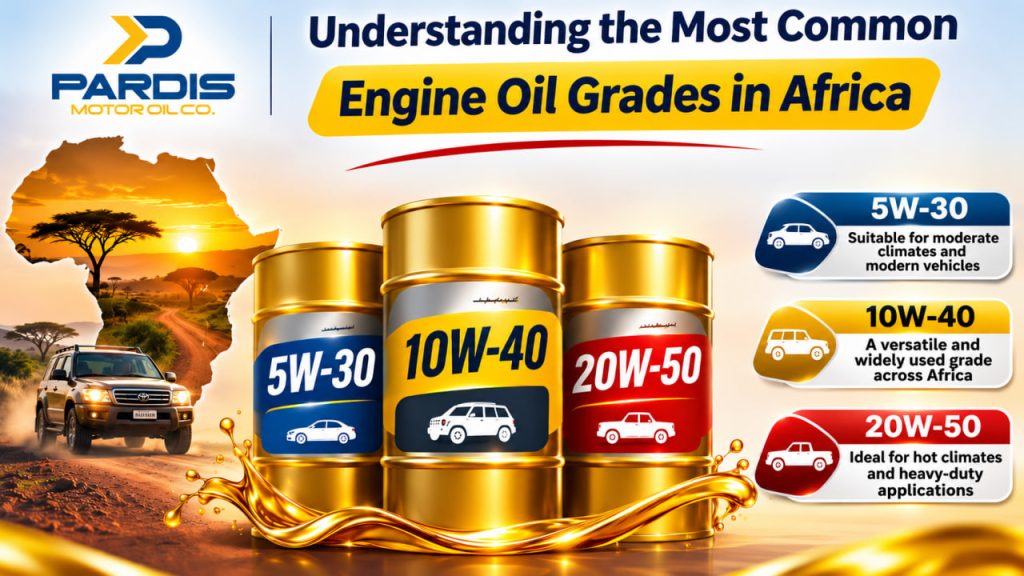
Understanding Engine Oil Grades in the African Market
The market for engine oil grades in Africa is diverse due to differences in vehicle types, climatic conditions, and economic development across the continent. Older and newer passenger cars, diesel trucks, motorcycles, and industrial equipment all have different lubrication requirements.
Viscosity grades such as 20W-50, 15W-40, 10W-40, and 5W-30 are available and used in different parts of the African market. However, their market shares vary between countries, and the correct grade must always be selected according to the engine manufacturer’s specifications.
20W-50 Engine Oil: A Familiar Choice for Certain Older Engines
20W-50 is one of the established viscosity grades available in African lubricant markets. It is used in some older vehicles and engines for which the manufacturer permits or recommends this viscosity.
At normal engine operating temperatures, 20W-50 has a higher viscosity than grades such as 10W-40.
However, hot weather alone is not a sufficient reason to choose a thicker engine oil. Engine design, lubrication requirements, and manufacturer recommendations should remain the primary selection criteria.
15W-40 Engine Oil: Common in Commercial Transport and Diesel Engines
15W-40 plays an important role in commercial vehicles, trucks, and certain diesel-powered machinery.
This grade is suitable for engines whose manufacturers approve the relevant viscosity grade and performance specifications.
According to a market research estimate, the broader 15W-XX viscosity category accounted for approximately 39% of the East African automotive engine oil market by volume in 2025.
It is important to note that this figure refers to the entire 15W-XX viscosity category, not specifically to 15W-40, and it should not be interpreted as a market share for Africa as a whole.
10W-40 Engine Oil: An Established Grade for Passenger Vehicles
10W-40 is another recognized engine oil viscosity grade in passenger vehicle markets across Africa.
Compared with 20W-50, it provides more favorable low-temperature viscosity characteristics and belongs to the SAE 40 viscosity category at high operating temperatures.
10W-40 is suitable for vehicles whose manufacturers recommend or approve its use. In addition to viscosity, the oil must meet the required performance specifications and any applicable manufacturer approvals.
5W-30 Engine Oil: Growing Importance in Modern Vehicles
As newer vehicles enter African markets and engine technology continues to develop, lower-viscosity oils such as 5W-30 are becoming increasingly relevant in certain market segments.
In compatible engines, 5W-30 can help reduce viscous energy losses and contribute to improved fuel efficiency.
Market research covering East Africa also projects growing demand for the broader 5W-XX viscosity category.
However, 5W-30 is not limited to newly manufactured vehicles. Its suitability depends on the engine’s technical requirements and manufacturer recommendations rather than the vehicle’s model year alone.
Why Do Engine Oil Requirements Differ Across African Countries?
Several factors influence the demand for engine oil in Africa, including vehicle fleet age, the proportion of gasoline and diesel engines, driving conditions, fuel quality, consumer purchasing power, and vehicle manufacturer recommendations.
For example, the lubricant requirements of West African markets may differ from those of South Africa or North African countries.
Understanding the vehicle fleet, operating environment, and technical requirements of each market is therefore essential for lubricant manufacturers, exporters, and distributors.
Conclusion: Understanding Africa’s Engine Oil Market
The African engine oil market includes demand for established viscosity grades such as 20W-50, 15W-40, and 10W-40, alongside growing interest in lower-viscosity oils such as 5W-30.
Nevertheless, no single viscosity grade can be considered the best option for every vehicle across Africa.
Choosing the correct engine oil requires consideration of the SAE viscosity grade, API or ACEA performance specifications, and the engine manufacturer’s recommendations.
Pardis Motor Oil Company emphasizes the importance of understanding the technical requirements of export markets and selecting lubricants that match engine types, operating conditions, and applicable performance standards.